
What to Expect From your Session
Communication is key! We will ask what your concerns are and what goals you have for your horse.
We will observe your horse as they move both in hand and under saddle to help identify any restrictions and imbalances.
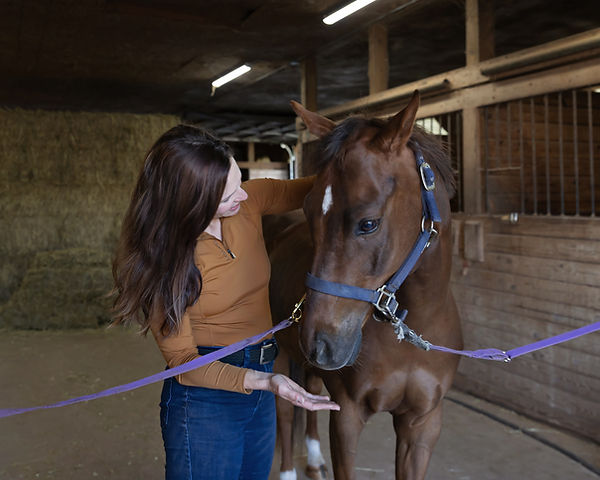
We will give your horse as much time as they need to feel comfortable. Beginning with short stroking, your horse will get used to touch using a calming rhythm. We will then palpate throughout your horse's body to triage areas of focus for massage therapy.
Every horse is unique and we will gauge the best place to begin working, paying close attention to your horse's cues at all times. You'll see us constantly watching their eyes, ears, nostrils and head carriage to help determine what they need. We also take the time to check in with your horse throughout the massage. Many horses want to check on our "magic hands" and how they make them feel the way that they do.
We will finish with passive stretches and might ask you to walk your horse in hand or do some light work under saddle to take advantage of the increased range of motion and establish new proprioception patterns.
We will discuss our findings with you and build a follow up plan to address your concerns and work to reach your goals.
Services
Our Services

1 hr 30 min
120 US dollars
1 hr
90 US dollars
Body Work
Dedication. Expertise. Passion.
....

The descending pectoral muscles adduct (bring towards midline) and protract (bring forward) the forelimb. They can be a common area of tension and respond well to a tapotement technique called cupping.

Working on mobilizing the scapula. Your horse's scapula has numerous muscular connections. Here I'm working near the subclavius, which stabilizes the shoulder.

Working on the pectorals. This area is a common point of tension because of the proximity to the girth.

Working on the superficial trapezius muscle as well as the deeper back muscles. This area at the withers is a common area of tension.

Checking in with your horse to make sure that my pressure is comfortable yet sufficient.

The hind! My favorite place to work. Your horse's locomotion is generated from behind and it's directly connected to the back muscles through the thoracolumbar fascia. Relieving tension in the hind directly affects the back muscles.

Working on the gluteal muscles while checking in to make sure that my pressure is comfortable for your horse.

The bones of your horse's forelegs aren't actually connected to their spine. You read that right! This is to protect their spine from the forces of concussion during the landing phase. Instead, the forelegs are held in place by a complex system of muscles called the thoracic sling.

The tensor fasciae latae (TFL) is another common source of tension for horses. This superficial muscle flexes the hip and extends the stifle. It's utilized for a longer portion of the swing phase in faster gaits such as canter, demonstrating it's role in stabilization of the hind during movement.

I'll always take the time to check in with your horse when I am working. Subtle cues from their eyes, nose and ears help me to determine how they are feeling. I also like to take the time to connect with your horse to give them a moment to process and find relaxation.

Working on the intercostal muscles. These muscles sit between the ribs and aid in inspiration. Mobilizing these muscles can help your horse's thorax to balance and make their breathing easier.

Utilizing a technique called stripping where I'm anchoring part of the muscle with one hand and putting the rest of the muscle under tension as I gently pull the fibers.

Working my way down the leg, utilizing the heart meridian according to Traditional Chinese Medicine. This point, on the medial side of the leg is a source of relaxation for your horse.

Working on the extensor carpi radialis. This is the primary extensor muscle for the knee joint.